

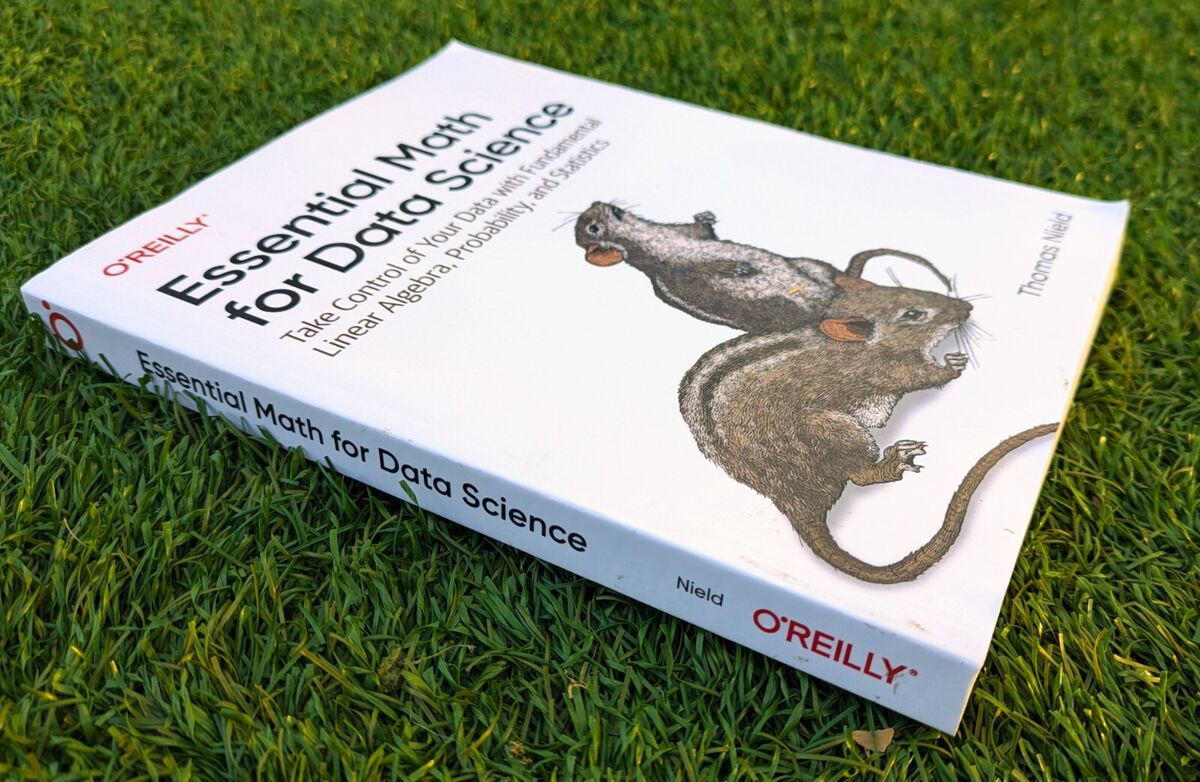
Essential Math for Data Science
The book Essential Math for Data Science by Thomas Nield fits squarely into the paradigm of Explainable AI (XAI) by addressing the fundamental “black box” problem: using algorithms without understanding their internal mechanics.
In the context of XAI, the ability to explain a model’s decision is inextricably linked to understanding how that model was constructed mathematically. Here is how this book contextualises within that framework:
The Foundation of Explainability
True explainability requires moving beyond calling functions in scikit-learn to understanding the calculus and linear algebra that drive optimisation.
-
Glass Box vs. Black Box: By mastering the underlying math (matrix decomposition, derivatives, probability density), you transition from treating algorithms as “black boxes” to viewing them as “glass boxes.” You can explain why a model made a prediction because you understand the mathematical operations that transformed the input into the output.
-
Interpreting Weights and Biases: A deep grasp of linear algebra allows you to interpret feature importance and vector interactions, which are central to explaining linear and logistic regression models.
-
Statistical Significance: The book’s focus on hypothesis testing and p-values is critical for uncertainty quantification. In XAI, it is not enough to give a prediction; one must also explain the confidence level and the statistical validity of that prediction to stakeholders.
-
Neural Networks: To explain deep learning (often the most opaque of models), one must understand the incremental calculus (backpropagation) and linear algebra that define it. Nield’s approach to building these from scratch ensures you understand the “why” behind a neural network’s behaviour, not just the “how.”
For practical application and code samples that demonstrate these mathematical concepts in action, you can access the accompanying repository here: https://github.com/HCXAI-Research/essential_math_for_data_science
Appreciation of Basics
As you noted, an appreciation of the basics is key to understanding how algorithms are built. In XAI, trust is built on transparency. You cannot effectively explain the behaviour of an algorithm—especially when it fails or exhibits bias—if you do not understand the mathematical axioms it is built. This book provides the “first principles” knowledge necessary to audit, debug, and explain models responsibly.
Resources
You can purchase the book to start building this mathematical foundation at the following links: